
Visit our YouTube channel by clicking here
In Traditional Chinese Medicine, the theory of the 5 elements, known as Wü xíng, plays a fundamental role.
This theory describes the relationship between the different elements of nature and how they are reflected in each of us, influencing the balance of our health.
The 5 elements are:
Fire
Water (水, shǔi),
Wood
Metal (金, jīn)
earth (土, tǔ).
Each element has particular characteristics and is associated with climate, season, color, emotion, flavor, time of day, organs, viscera and behavioral traits.
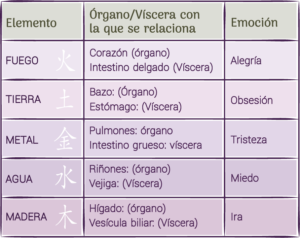
The imbalance of these elements determines the diagnosis of each patient, so it is essential to understand how they interact with each other.
The elements are related to each other and can influence the functioning of others through two main cycles: the generation cycle and the dominance cycle.
Generation cycle and dominance cycle
The generation cycle (also called creation cycle) 生 shēng. Describe how each element feeds and strengthens the next in the cycle.
- The wood feeds the fire,
- Fire produces earth with its ashes
- The earth houses minerals,
- Minerals (metal) feed water,
- Water gives life to wood.
On the other hand, according to the cycle of domination (also called star of destruction) 克 kè. It shows how one element can control or weaken the next in the cycle.
- The wood is nourished by the earth,
- The earth retains water,
- The water puts out the fire,
- Fire melts metal,
- Metal cuts wood.
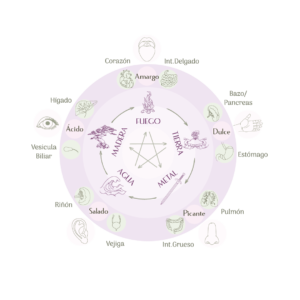
These cycles are fundamental to understanding balance and imbalance in Traditional Chinese Medicine, and allow the doctor to identify and treat imbalances in each patient's body.
Another important aspect in Traditional Chinese Medicine is the concept of the Biological Clock. According to this concept, each organ has maximum functioning during certain hours of the day.
Conocer el reloj biológico nos permite mejorar nuestra calidad de vida y también puede ser utilizado como elemento de diagnóstico y tratamiento.
Por ejemplo, si se experimentan ciertos síntomas o te despiertas constantemente durante la noche en un horario específico, esto puede indicar un desequilibrio en el órgano correspondiente. Sin embargo, es crucial destacar que el médico basará su diagnóstico en varios elementos y no solo en el reloj biológico.
A continuación, presentamos una guía del reloj biológico y las acciones recomendadas para cada período del día, enfocadas en aprovechar la energía de los órganos
Biological Clock and its corresponding actions
1:00 – 3:00 am:
Active Organ: Liver.
Recommended action: Sleep. During this period.
Recommended action: Sleep. During this period.
3:00 – 5:00 am:
Active Organ: Lung.
Recommended action: Sleep or perform breathing exercises.
The lung enriches the body with oxygen during these hours.
5:00 – 7:00 am:
Active Organ: Large Intestine.
Recommended action: It is a good time for intestinal evacuation, taking advantage of the elimination and evacuation function of the large intestine.
7:00 – 9:00 am:
Active Organ: Stomach.
Recommended action: Breakfast.
The stomach is at its peak functioning for nutrient absorption during this period.
9:00 – 11:00 am:
Active Organ: Spleen.
Recommended action: Perform the most demanding tasks of the day.
The spleen transmutes food into blood and usable energy for the muscles.
11:00 – 1:00 pm:
Active Organ: Lung.
Recommended action: Lunch.
Durante este período, el corazón impulsa la sangre de manera óptima.
1:00 – 3:00 pm:
Active Organ: Small Intestine.
Recommended action: Perform simpler actions that don't require much effort, such as a short, slow walk.
The small intestine is responsible for separating, distributing and assimilating nutrients.
3:00 – 5:00 pm:
Active Organ: Bladder.
Recommended action: Do calmer activities, such as studying.
During this period, the bladder is responsible for storing and evacuating urine.
5:00 – 7:00 pm:
Active Organ: Lung.
Recommended action: Practice activities that cultivate the spiritual, such as Tai Chi, Qi Gong, or meditation.
The kidney removes waste and excess fluid from the body.
7:00 – 9:00 pm:
Active Organ: Pericardium.
Recommended action: Time with family, friends or as a couple.
El pericardio apoya al corazón durante estas horas.
9:00 – 11:00 pm:
Órgano Activo: Triple Recalentador.
Recommended action: Perform relaxing activities to prepare for sleep.
The triple superheater is responsible for oxygenation, circulation and digestion.
11:00 – 1:00 am:
Active Organ: Gallbladder.
Recommended action: Sleep.
During this period, the gallbladder secretes bile and assimilates healthy fats.
In summary, the theory of the 5 elements and the biological clock are essential pillars of Traditional Chinese Medicine.
Understanding how the elements interact and taking advantage of the maximum functioning of each organ according to the biological clock can help maintain balance and promote overall health. If you experience imbalances or persistent symptoms, it is important to seek the advice of an Oriental Medicine professional for proper diagnosis and treatment.

4 Comments
I like your writing style truly enjoying this website.
Add Comment